Post-crisis regulation and bond liquidity

One of the best blogs to follow about research on banking is the blog by the NYFed, Liberty Street Economics. In a recent post, they discuss the results of their JME paper on whether post-crisis regulation is affecting bond liquidity via constraints on dealers’ balance sheets. The question is very important to understand all the consequences of such regulations, both intended and unintended, which is key to evaluate them. The summary that they wrote is very nice so I will not add more than just to recommend the reading.

Posted in Uncategorized | Tagged , | 1 Comment

What will happen with Dodd-Frank?

Post-crisis banking regulation seems to be under thread given the direction that the Trump presidency is taking on this matter. We have a US Representative asking Yellen to basically sit down and do nothing until the President figures out how he wants the new banking regulation to look like; we have the chair of the Financial Services Committee saying that Dodd-Frank is a disaster for the economy; and the President has asked the Treasury Department to review financial regulation.

What should we expect? There is little certainty (after all, this is Trump’s era) but one of the principles highlighted by the US President is to “prevent tax-funded bailouts”. A somehow optimistic view would suggest that the US might be dropping some of the restrictions imposed in the Act (many coming from the Volcker Rule) and maybe focus more on capital, in line with the Minneapolis Fed approach. This seems to be the FT preferred approach.

A less optimistic view, on the other hand, would suggest a clear walking back of many of the post-crisis regulatory reforms, lifting the restrictions of banks to engage in proprietary trading and investment-banking-type of activities, as well as reducing the amount of capital the largest banks need to hold. A key insight of the crisis is that banks were clearly undercapitalised relative to the riskiness of their balance sheets; walking back on these reforms is a clear sign that the policy cycle has shifted and that the “this time is different” myopia has come way faster than expected.

I finish by leaving Larry Summer’s views on the matter, which are interesting as always.

Posted in Uncategorized | Tagged , | Leave a comment

QE – The story so far

Three months ago, Andy Haldane came to Cass to give the Dean’s Lecture. The lecture was about Quantitative Easing. It is now available on Youtube here, so enjoy! The working paper version of this work can be found here.

Posted in Uncategorized | Tagged | Leave a comment

Ending too big to fail

One of the most interesting sessions in Chicago during the last ASSA Annual Meeting was about ending too big to fail. Neel Kashkari presented the Minneapolis Fed plan and Markus K. Brunnermeier and Randall Kroszner gave their view on the plan.

The plan involves a massive increase in common equity requirements for systemic banks, to 23.5% in the first instance, potentially going up to 38%. Kashkari’s rationale for the plan is clear: the resolution framework, which should make bondholders absorb losses before considering a bailout, will not work in a crisis. Therefore, the total loss absorbing capacity of the bank should be formed of common equity.

For the resolution framework to work it needs to be credible. If nobody believes it will work—i.e., if nobody believes that the junior bonds will absorb losses if the bank enters into resolution—prices will not incorporate this possibility. You need a critical mass of market participants to anticipate the losses. If that is not the case, once a supervisor tries to trigger losses on bondholders we can have an extreme re-pricing of other bonds, potentially leading to a negative contagion effect.

So is the resolution framework credible? Unfortunately, we might only find out in a crisis. Even if some bondholders absorb losses in some cases—for instance, Banco Espirito Santo—these are typically not full-blown crises but instead individual failures. And even in such cases, the political appetite does not seem to be imposing losses on bondholders, such as with Monte Paschi de Sienna.

If the resolution framework is not credible, Kashkari argues, we should make sure that all loss-absorbing capacity is made up of common equity rather than junior and senior bonds. Hence, for systemic banks, the equity requirement should be around 23.5% of risk-weighted assets, similar to the phased-in TLAC requirements plus Basel III buffers (18% + 2.5% CCoB + GSIB buffer + CCyB).

The requirements would continue to increase up to 38% as long as the bank continues to be systemic. Interestingly, the net benefits of the first step (23.5%) are higher than those of the second step (38%). If the cost-benefit analysis is credible, they should then stop at 23.5%, but Kashkari justified going up further by claiming that systemic crisis and bailouts have broader costs than just output losses: for instance, political polarisation and social unrest. For this reason, he said, they wanted to decrease the probability of such crisis below 10% in the next 100 years.

Posted in Uncategorized | Tagged , | 1 Comment

The “crisis” of economics

Andy Haldane, chief economist at the Bank of England, has recently repeated the claims about the crisis of the economics profession. I have discussed this issue with many people since the financial crisis, and I was going to write something about it here, but David Miles did it first and much better in the FT today. A must read.

Posted in Uncategorized | Tagged | Leave a comment

Leverage ratio and repo activity

In the previous post, I briefly mentioned some of the potential issues of the leverage ratio (LR). To be fair, these are only issues to the extent that the regulators did not foresee and did not include these consequences in the cost-benefit analysis.  For instance, in the case of repo activities, it could well be that regulators are fine with banks pulling back from these activities. But in order to do any of this, we first need to understand the effects of the different policies that are being put in place.

Allahrakha, Cetina, and Munyan (2016) look at how banks reacted after the announcement of the LR regulation. They focus on the tri-party repo market and use the empirical strategy known as difference-in-differences: they look at how banks more affected by the leverage ratio reacted as compared to less affected ones. They have daily dealer-level activity information, so they are able to observe this market at a fairly granular level.

A key element in this type of papers is to indentify the ‘control’ and the ‘treatment’ groups. In this case, they define six different groups, although I will only mention four. The ‘control group’, which in this case only means the group that does not have a dummy variable in the regression, is formed by dealers that are part of a bank holding company (BHC) that is not subject to the LR. Another ‘control group’ that is looked at is formed by dealers that are not part of a BHC (and hence not subject to the LR either). The two treatment groups are: dealers that are part of a BHC with a LR below 3.5% in 2012, and dealers that are part of a BHC with a LR above 3.5% in 2012. The idea is that the former should react more as it is more constrained by the LR.

The second important element is to decide when is the treatment applied. This is fuzzier that it seems. In December 2010, the BCBS issued the Basel III framework where there was a reference to the LR. In June 2012, the US regulators issued a proposal. In June 2013, the BCBS issued a consultative document. In July 2013, the US regulators finalised the rule. And so on… So when should the treatment had taken place? They settle for June 2012, and I would have chosen the same date. But looking at the data they conclude that the series breaks on November 30th 2012. Why?

Nothing really happened that day, at least that we publicly know, about the LR. The authors claim that “This corresponds to the public comment period following the first announcement… and suggest bank holding companies may have assessed the impact of the proposed rule on their operations and responded proactively“. But the public comment period actually ended more than a month before, after it was extended. And more importantly, the fact that they are already assuming that the LR had an aggregate effect should alert anyone interested in approaching empirical research as agnostically as possible.

The authors show, using the diff-in-diff approach, that more affected banks reduced repo activities more as compared to the rest. There is no evidence that less-affected banks reduce repo activities more than not affected ones. This is important because it means that banks do behave differently if they are more LR-constrained. Moreover, the most affected banks seem to increase repo activities using riskier collateral (equities and corporate bonds). On the other hand, non-bank dealers seem to increase, relative to not-affected bank dealers, repo activities, in particular using safer collateral (US treasuries and Agency MBSs).

The authors claim that this is evidence on the unintended consequences of the LR: decrease in repo activity, risk-shifting by more affected banks towards riskier collateral, and part of the market moving towards the non-bank financial sector. All of this should be worrisome. But there are concerns about the approach. They do not use time (for instance, week or month) fixed effects even though they are not looking at the pure time dimension of the treatment. Moreover, why is it riskier that the safest part of the repo market moves to the non-bank sector as opposed to having banks with a leverage ratio below 3.5% playing a key role in this market?

I think it is reasonable to conclude that more LR-constrained banks reduced repo activities. But I have not seen even relatively clear evidence that the LR caused the reduction in repo activities, and I do not buy the “concerns” that the authors express. I understand that institutions have agendas, but it would be good for everyone to start looking at the evidence without their conclusions already made up.

Posted in Uncategorized | Tagged | 2 Comments

The unintended consequences of the leverage ratio

The leverage ratio is one of the main innovations in the new banking regulatory framework, Basel III. It imposes a minimum amount of Tier 1 capital that depends on the size of the balance sheet, without any consideration for the riskiness of the assets. It complements the risk-based capital regulation that proved to be ineffective during the crisis—many banks had healthy capital ratios even though they were under severe stress. The minimum leverage ratio requirement under Basel III is 3% and might be supplemented with a GSIB leverage ratio surcharge.

But this requirement might have unintended consequences. In particular, low-profit but balance-sheet-intensive businesses, for which risk weights are very low, might become less profitable with the leverage ratio. The leverage ratio only applies at the consolidated group level, and thus it is not obvious why it should affect particular business activities if banks themselves are not constrained by this requirement. But there might be reasons: for instance, more complex institutions could find it easier to price different activities depending on which requirement binds in each case. In other words, banks might price high loan-to-value mortgages using the risk-based capital requirement, but price repo activities using the leverage ratio.

This can also apply to market-making activities, or banks acting as dealers: they might be less likely to hold the bonds on the balance sheet and hence less likely to provide liquidity. Some market participants, especially from the financial industry, claim that post-crisis regulation is behind the perceived reductions in market liquidity in the recent years, sometimes pointing at the leverage ratio as the main reason.

At the end of the day, however, this is an empirical question. It seems that dealers’ balance sheet utilisation has decreased, but for treasuries and corporate bonds at least, NYFed researchers do not find a reduction in market liquidity . Even if one observes a reduction in market liquidity, the key step is to link this reduction to the new banking regulation.

In an era of granular data and constant regulatory innovation (the perfect scenario to run tests), one would expect plenty of research currently looking at this issue. But we are not there yet. Nevertheless, the Office of Financial Research (OFR), which depends on the Department of the Treasury in the US, has recently published a working paper looking at how the leverage ratio is affecting tri-party repo activities. I will discuss the paper in the next post.

Posted in Uncategorized | 3 Comments

BU post: Proprietary Trading: Evidence from the Crisis

Well, more than a month after saying that I was back… well, I am. And my post for the Bank Underground blog (the blog of the Bank of England staff) is finally out. But the really great thing is that, while reading Matt Levine’s Bloomberg column—as I do every day—I realised that he mentioned our post! How cool great is that!

What is the post about? Here it is the first paragraph:

What are the consequences of proprietary trading? Banks typically hold and trade a significant amount of securities, and during the financial crisis, many of these securities suffered strong price declines. How did banks react? This is precisely what we investigate for the case of Germany in a recently published paper. We find that some banks increased their investments in securities, especially for those securities that suffered price drops. This strategy delivered high returns; but at the same time, these banks pulled back on lending to the real economy, since during the financial crisis they could not easily raise new (long-term) funding. Our findings suggest that proprietary trading during a crisis can lead to less lending to the real sector.

Posted in Uncategorized | Tagged , | Leave a comment

Guess who’s back!

Yes, it’s me—as far as I know, Eminem is not launching a new record. Although, to be honest, I haven’t check. Let me see. Nope, Wikipedia doesn’t say anything about it.

So why was I gone? Because I was (still am) working at the Bank of England. And hence, it was not appropriate to be writing about papers. Also, I had a tone of work to do—yes, that’s the real reason… But things changed about a month ago, when I got an offer from Cass Business School to be a lecturer. I decided to take it, and I’ll be starting in a couple of months, give it or take.

This will give me much more time to read and write papers, which I am surely looking forward to. It will also allow me to write here regularly. The next post will then be next weekend. See you then!

Posted in Uncategorized | Tagged | Leave a comment

Global financial cycle and Germany

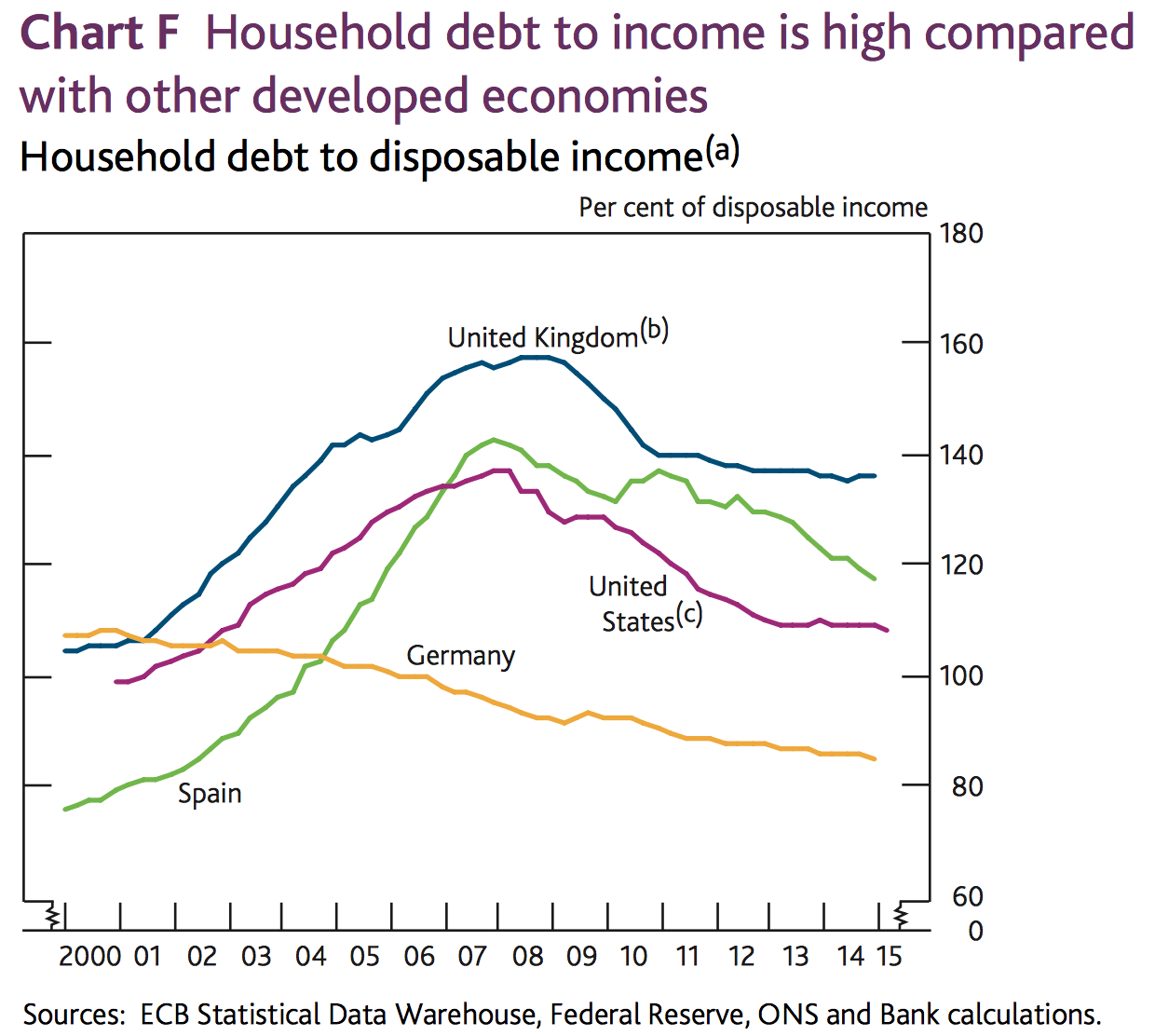
The importance of the global financial cycle is currently at the center of many policy and academic discussions. Especially dangerous for emerging economies, the highly synchronised credit booms and busts that advanced economies suffered recently suggests that it is also a problem for the EU and the US. However, the following graph, extracted from the last BoE Financial Stability Report (yes, you can tell I’m starting working there in three weeks), shows a country that did not suffer any credit boom.

Screen Shot 2015-07-02 at 06.33.45What did Germany do? Obviously, the German difference was not centered around banking regulation, and was mainly related to very important structural reforms, as this JEP article explains. I take two things from this picture: one, even if you are very integrated in the global market -as Germany is- there are ways to prevent a ‘bad’ credit boom from happening. Second, these ways may go well beyond banking regulation.

Posted in Uncategorized | Leave a comment