Data visualisation and macro-prudential regulation

During the pre-crisis period, or the micro-prudential one, mapping the whole financial sector was not very important: the focus was to ensure individual solvency. Nowadays two things have changed: much more data is being collected by supervisors, and much of the emphasis has shifted towards the stability of the whole system. And the very first step for a macro-prudential approach is to understand your own financial system. The last Quarterly Bulletin from the Bank of England does precisely this: mapping the financial system. It is just a first approach, still in a too high level to be used for macro-prudential supervision, but this is where things are going. They have a nice youtube video:

They do not include some parts, such as derivatives, due to huge gross positions that are netted out and would distort the rest of the map (something like showing, in the same graph, the risk premia of Greece and other countries during the last 10 years). Nevertheless, I hope to see an article just on derivatives in the future, because it is important to know which risks and sectors banks are hedging.

The next article in the same Bulletin talks about interconnectedness. This issue is very important regarding the concerns for systemic institutions, as more connected can have worse effects if they suffer some shock. But there are a lot of ways two institutions can be connected: direct interbank exposure, common exposure to borrowers, common exposure in securities, derivative exposures, … They show the UK networks for the first and the last case. More of this type of exercise is needed

Posted in Uncategorized | Leave a comment

Job market placement

After several months I write again. One of the most important reasons for taking so long has been the job market process. As some of you may know, during the last year of our PhD studies we participate in a centralised process to access the job market. In particular, we apply to several institutions during autumn, wait for calls / e-mails to be interviewed in the ASSA meeting at the beginning of January, and then wait for calls /e-mails to be invited to the institutions for a day interview (fly-out). After the fly-out, it’s only a matter of whether they decide to make you an offer or not.

I have been extremely lucky and the Bank of England has offered me a position as PhD research economist. Moreover, I will be working in a very interesting group dedicated to ‘medium-term regulatory strategy’. I’ll explain more of the exact type of work that I do once I start, which won’t be until September. For now, I’m focused on finishing the thesis, in particular the second paper, and the last classes to teach. Because this is one good thing about working at a central bank: you don’t have to teach! Those of you who know me know that I don’t dislike teaching, I may even say that I enjoy it. What I dislike is all the bureaucracy attached to teaching. Whatever, these courses that I am teaching now will be the last ones for several years.

Later I may give you some tips for those of you facing the job market in the next years. But today, apart from the fact that I wanted to explain my placement, I also wanted to say that I’m back.

Posted in Uncategorized | Leave a comment

Monetary Policy and Risk-Taking

In the last post we saw that Jiménez et al. (2012) showed that banks react to a monetary policy expansion by increasing credit supply, and that is particularly strong for ‘weaker’ banks. This is what it is known as the ‘lending channel’ of monetary policy. But something that has worried many economists is the fact that the increase in credit supply might go for riskier borrowers. In other words, what is known as the ‘risk-taking channel’ of monetary policy.

Jiménez et al. (2014) study this issue. They use again the Spanish credit register and estimate an econometric model with two stages: in the first stage, they estimate the probability of granting a loan (given that the firm has a loan application with the bank), while in the second stage they study the quantity of the loan. It is very important to study credit supply with this two-stage procedure (if one has loan applications data, obviously) because there is a sample selection bias if one only studies the quantity of the loan: one would only be observing firms for which the bank decided to give them a loan, which can be different from those that were not granted the loan.

They use fixed effects to exhaust the variation of the dependent variables so that they can identify the channel. In particular, the channel is a change in the composition of credit supply after a decrease in the policy rate: weaker banks increasing credit supply more to riskier firms. Crucially, this is a bank-firm-time channel: bank because of the differences in balance-sheet strength, firm because of the differences in riskiness of the borrowers, and time because of the monetary policy shocks. This is very important because there are other effects from decreasing the policy rate: we already know about the ‘lending channel’ (weaker banks expanding credit supply more), and there are potentially changes in the composition of credit demand (i.e., changes in the risk of firms demanding credit). The way they control for the first effect is by using bank-time fixed effects: in other words, controlling for the average probability of granting a loan and the credit given for each bank at each time. For the second effect, they rely, as in the previous paper, on firm-time fixed effects to control for credit demand.

Their results show that a decrease of 1 percentage point in the overnight rate is associated to a 8.2% higher probability of granting a loan to a risky firm and 16.1% more credit to that risky firm for weaker banks. This can be seen in the last column of Table II. Notice that when they use bank-time and firm-time fixed effects they cannot study other interesting results: for instance, does the average bank lend more to risky firms when the interest rate goes down? Since this is a firm-time issue, firm-time fixed effects capture it. Nevertheless, they report in the same table the same specification introducing fixed effects and interactions one step at the time. We can see that, in Column 4, the average bank tends to grant fewer loans to risky firms when the interest rate decreases, but they give more credit to risky firms if they are granted the loan as compared to safer firms. Taking both stages into account, the total impact of a lower policy rate on credit supply to risky firms is positive for the average bank (bottom part of Column 4, right before the fixed effects).

This paper has strong policy implications, even more so now that several central banks are in charge of both monetary policy and financial stability. The results of Jiménez et al. (2014) show that lower short-term interest rates induce banks to take on higher risk through lending, and that this is even worse for lowly-capitalised banks. Put it differently, they show that monetary policy actions have clear financial stability consequences.

Reference:

– Jiménez, G., S. Ongena, J.-L. Peydró, and J. Saurina, 2014, “Hazardous Times for Monetary Policy: What do Twenty-Three Million Bank Loans Say about the Effects of Monetary Policy on Credit Risk-Taking? ,” Econometrica 82(2): 463-505.

Posted in Uncategorized | Tagged , , , | Leave a comment

Monetary Policy and Credit Supply

In the last post I discussed the ‘new empirical banking literature’. I explained that the main advance of this literature is to control for any firm heterogeneity, which determines most of the credit demand. They can do that because they have access to credit registers, which have loan-level data. In this post I will discuss Jiménez et al. (2012), which use the Spanish credit register to understand how monetary and economic shocks affect bank credit supply.

Theoretical papers suggest that negative economic shocks and contractive monetary policy not only reduce credit supply, but they do it more for ‘weaker’ banks (in terms of balance-sheet strength). The authors look at the probability that a loan application is granted depending on the capital and liquidity ratios of the banks when there is a monetary policy or an economic shock.

In the case of Spain, the credit register has better information than in most other countries because it contains not only the actual loans given, but also the loan applications. When a firm wants to borrow from a bank from which it is not borrowing yet, the bank fills in a loan application (with information on the firm and the quantity demanded) to obtain information regarding other loans of this firm.

As in each credit register, the data is a panel with three dimensions: bank, firm, and time. The variables of interest are bank-time-level (capital and liquidity ratios, which are proxies for the strength of a bank) and time-level (change in GDP and change in short-term rate). Moreover, the dependent variable is bank-firm-time varying. Hence, they can use firm fixed effects or even firm-time fixed effects; that is, they can control for any observed or unobserved time-varying heterogeneity across firms.

They find (Table 2) that increases in the interest rate are associated to a lower probability of granting a loan, and this association is stronger for banks with low capital and low liquidity ratios. Moreover, decreases in economic activity are also associated with lower probability of granting a loan, and this is stronger for banks with lower capital ratios.

They further control for firm-month and loan fixed effects (Table 3). This means that they look at each firm that applies for more than one loan in a given month, and see whether this loan is granted depending on bank capital and liquidity and their interaction with interest rate and monetary policy. Given that they use firm-month fixed effects, they can no longer identify the average effect of the shocks; instead, they can identify the importance of the bank variables as well as their interaction with the shocks. The results from Table 2 are mostly confirmed: increases in the policy rate are associated to a lower probability of granting a loan for weak banks as compared to strong banks, and negative economic shocks seem to have the same effect.

This paper provides the first and clearest evidence on the monetary policy transmission channel called ‘the bank lending channel‘, and in general on the importance of bank balance sheet strength for credit supply. In the next post I will talk about the second paper using the Spanish credit register, which looks at the ‘risk-taking channel‘ of monetary policy transmission.

References:

– Jiménez, G., S. Ongena, J.-L. Peydró, and J. Saurina, 2012, “Credit Supply and Monetary Policy: Identifying the Bank Balance-Sheet Channel with Loan Applications,” American Economic Review 102(5): 2301-26.

About the theoretical papers, here there are some:

– Bernanke, B. S., and A. S. Blinder, 1988, “Credit, Money, and Aggregate Demand,” American Economic Review 78(2): 435-39.

– Bernanke, B. S., and M. Gertler, 1989, “Agency Costs, Net Worth, and Business Fluctuations,” American Economic Review 79(1): 14-31.

– Bernanke, B. S., and M. Gertler, 1995, “Inside the Black Box: The Credit Channel of Monetary Policy Transmission,” Journal of Economic Perspectives 9(4): 27-48.

Posted in Uncategorized | Tagged , , | Leave a comment

New Empirical Banking Literature

During the last six years, there has been an important increase in top-published articles on empirical banking. Needless to say, the financial crisis has contributed to this increase; however, the most important change has come from the availability of very detailed data, mainly through credit registers. In a credit register (which is usually in the central bank of the country) you can find data at bank-borrower-time level; in other words, you can know, at each month/quarter, how much borrower X is borrowing from bank Y. This allows to better identify credit supply, which had been the main limitation of this literature in the ‘pre-credit-registers period’.

This literature is mainly interested in knowing how banks change their credit supply as a result of a shock. How could we empirically look at this question? To make it more precise, we can use the case that Iyer et al. (2014): what was the reaction (in terms of credit supply) of Portuguese banks to a shock in the international interbank markets in August 2007? An obvious answer would be to use a diff-in-diff approach: we see how bank credit changed after the shock depending on how exposed to the shock banks were. Without a credit register, only looking at the total credit given by the banks to the corporate sector, the main identification assumption of this approach would be that the pool of borrowers of the different banks react similarly to the shock. Put it differently, that the credit demand change after the shock is uncorrelated with how much banks are borrowing from abroad.

This assumption is not very realistic. Banks that borrow more from abroad may be lending more to firms that are also more exposed to international markets. If that were the case, the result could be driven by these firms demanding less credit as a result of the shock, even if more affected banks did not change their credit supply differently.

With the credit register information, we can do the same diff-in-diff analysis but in a finer way: we analyse the change in credit of a bank to a particular borrower after the shock. Given the structure of the data, we can use borrower fixed effects. This allows us to do the following: we can compare how credit given by two or more banks (differently affected by the shock) to the same borrower changes after the shock. With the borrower fixed effects we control for the average change in credit for each firm, which can be understood as controlling for credit demand. Now the identification assumption has changed: we are assuming that the credit demand of a particular firm borrowing from two or more banks changes similarly for each of these banks. In other words, if firm X is borrowing from bank Y and Z when the shock happens, we require that the change in credit demanded by firm X to bank Y is similar to the one demanded to bank Z. Since credit demand is usually driven by firm fundamentals, then this assumption seems more realistic.

Two notes to finish. First, by using this empirical approach we are restricting our attention to firms borrowing form at least two banks. Second, these papers usually go one step further and, after showing the reduction of credit supply by more affected banks, they look whether firms have been able to substitute credit by borrowing from other, less affected banks. At the end of the day, this is what really matters to understand if the reduction in credit supply can have real effects.

In the next post I will discuss the results of three papers that use the Spanish register to understand how banks react to monetary, economic, and regulatory shocks.

References:

– Iyer, R., J.-L. Peydró, S. Lopes, and A. Schoar, 2014, “Interbank Liquidity Crunch and Firm Credit Crunch: Evidence form the 2007-2009 Crisis,” Review of Financial Studies 27(1): 347-72.

If interested, look at the very first paper using this empirical approach in banking:

– Khwaja, A. I., and A. Mian, 2008, “Tracing the Impact of Bank Liquidity Shocks: Evidence from an Emerging Market,” American Economic Review 98(4): 1413-42.

Posted in Uncategorized | Tagged , | Leave a comment

Research productivity of PhD graduates

Less than one year to finish my PhD -if everything goes as it is supposed, and bad luck and me do not cross paths-, so it is a good time to know what we should expect when we start working for real -with good salary and these things. In the last issue of JEP we can find a quite interesting article for this: ‘The Research Productivity of New PhDs in Economics: The Surprisingly High Non-Success of the Successful’, by John P. Conley and Ali Sina Önder.

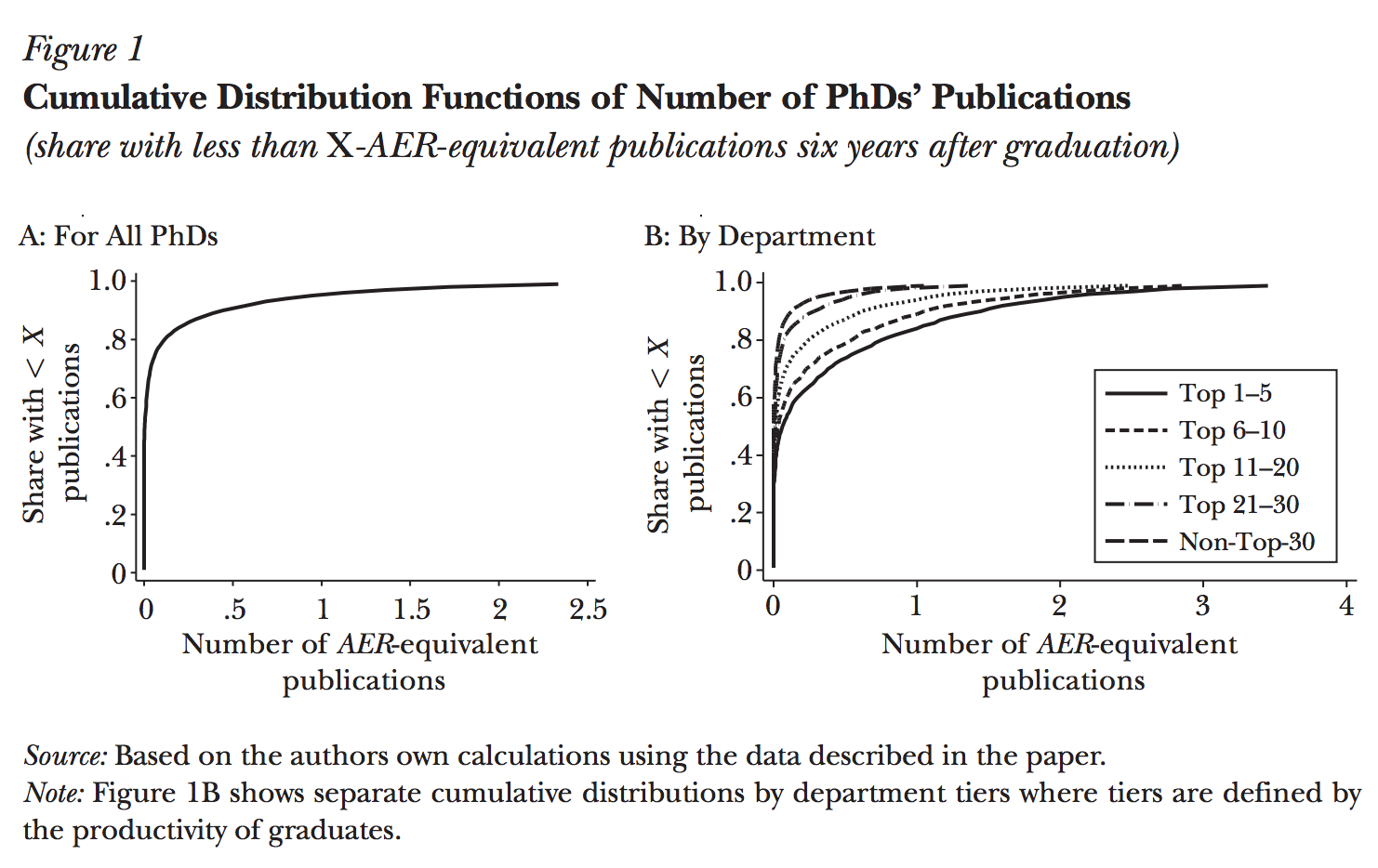
The authors collect data on economics PhD recipients from US and Canada and tracks their publications for the first 6 years after graduation (the duration of the typical tenure track). They rank the journals following a previous paper (Kalaitzidakis et al. (2003)); in particular, each publication is converted into a number of AER-equivalent. This method is a bit strange (2 REStuds = 1 AER? 3 JME (3!!!) = 1 AER?; and what about the top finance journals -JF, JFE, RFS?), but they also say that the results are qualitatively robust to the rank.

And what are the results? They find that only the very best (in terms of research production) of each department do particularly well, and that the rest tend to be very similar regardless of the department. In other words, a median PhD from Harvard / MIT / Chicago is not very different (in terms of research productivity) that the median from another less successful department. The results are striking because they are very strong, as can be seen in their first Figure:

Screen Shot 2014-08-12 at 21.16.48

One needs to mention Princeton and Rochester. Princeton ranks 3rd or better at each percentile (until the median, see Table 2). This means that their graduates are always among the best three institutions among equally ‘research-ranked’ colleagues. Something similar happens with Rochester, an institution that ranks ‘only’ 10th when we look at the starts but that is always among the three best for graduates below the 90th percentile.

Another striking feature is that even for Top 5 institutions it takes a graduate among the best 20% to publish a single-authored AER-equivalent in their first 6 years.

There might be some caveats, though. I have already complained about the journal ranking and the missing journals. Moreover, it is not clear whether the authors also consider those publications that are accepted but not published (i.e., ‘forthcoming’) at the end of the 6-year-period. Since the numbers are very small, excluding those publications might have a significant impact on the conclusions.

Despite these caveats, this highlights the difficulty to publish in the very top journals and the toughness of the tenure track of the top institutions.

Posted in Uncategorized | Leave a comment

Credit cycles and systemic risk

CREI (a research institute sponsored by UPF) publishes the ‘Opuscles‘, which are usually written by a professor from UPF or UAB and describe the research interests of the author. The last number (35), published on December 2013, was written by my supervisor, and it talks about credit cycles and systemic risk. In a nutshell, it explains why banks may start lending ‘too much’, in particular because of problems inside the banking sector; it also talks about a very costly situation called a credit crunch, and it finishes discussing some conclusions on the role of macroprudential policy to help alleviate these problems. It is supposed to be for the general public, not only economists, so it is relatively easy to read. There is even a version in Catalan, translated by myself. So take a look at it in here if you are a little bit interested in the topic!

Posted in Uncategorized | Leave a comment

Past and present

Right after starting this blog, I had a crazy week of teaching. I actually enjoy teaching. It is one of these things that you never consider but, when you are somehow forced to do it, you change your opinion. I was teaching Banking. With slightly different names, but the two courses were about banking. Now, if you have known me for a long period, you may realise the ‘accident’ that this implies. My father has worked in banking his whole life, and my mother has been a teacher, surprise, her whole life. And I ended up teaching banking. It is amazing how the past can influence you. How, what you saw at home, the conversations you had with your parents, with other relatives, or even close friends, can shape your tastes and future decisions. The best thing is that you do not even realise it. You just, as Steve Jobs said once, connect the dots.

But right now I am in Frankfurt, working in a project at the Bundesbank. Have you ever been to Frankfurt? It is a weird city, it is like it has no soul, or at least I cannot see it. That is not a bad thing, I just mean that I am not used to it. Yet. On the other hand, I am enjoying the stay at the Bundesbank. Lots of work, but that is a good thing. I must admit a felt a bit overwhelmed at the beginning, having to work a lot and with almost no time to find a shared flat. But my wife has helped me with it, as always. And if I think about it, I have many friends around the world, that are not afraid of starting new adventures in different countries. Frankfurt is so close compared to Canada, US, or Venezuela. What do my friends have to do with this? Let me put it like this: I cannot lose to them.

Posted in Uncategorized | 2 Comments

Start

First day to work (I was sick last week) of a year that promises to be extremely interesting and exciting. In order to make it even better, I start this blog. I don’t know exactly what I am going to write about, but it will be a good way to keep track of the things I do, read, think about, etc. Nothing more, but nothing less. I must admit that blogging sounds very 2000s -and not 2010s-, but it’s always been kind of a hobby for me. And I feel particularly now that I am doing a lot of stuff at the same time and have very few chances to talk to friends about what I am doing. This is a good way to keep track, for me and for others.

I know I’ll talk at some point about research, about developments in the banking industry, about new regulation, about politics, about Catalonia, about movies, … But this first one is just to say hi. And I didn’t say it yet, so… HI!

Posted in Uncategorized | 1 Comment